
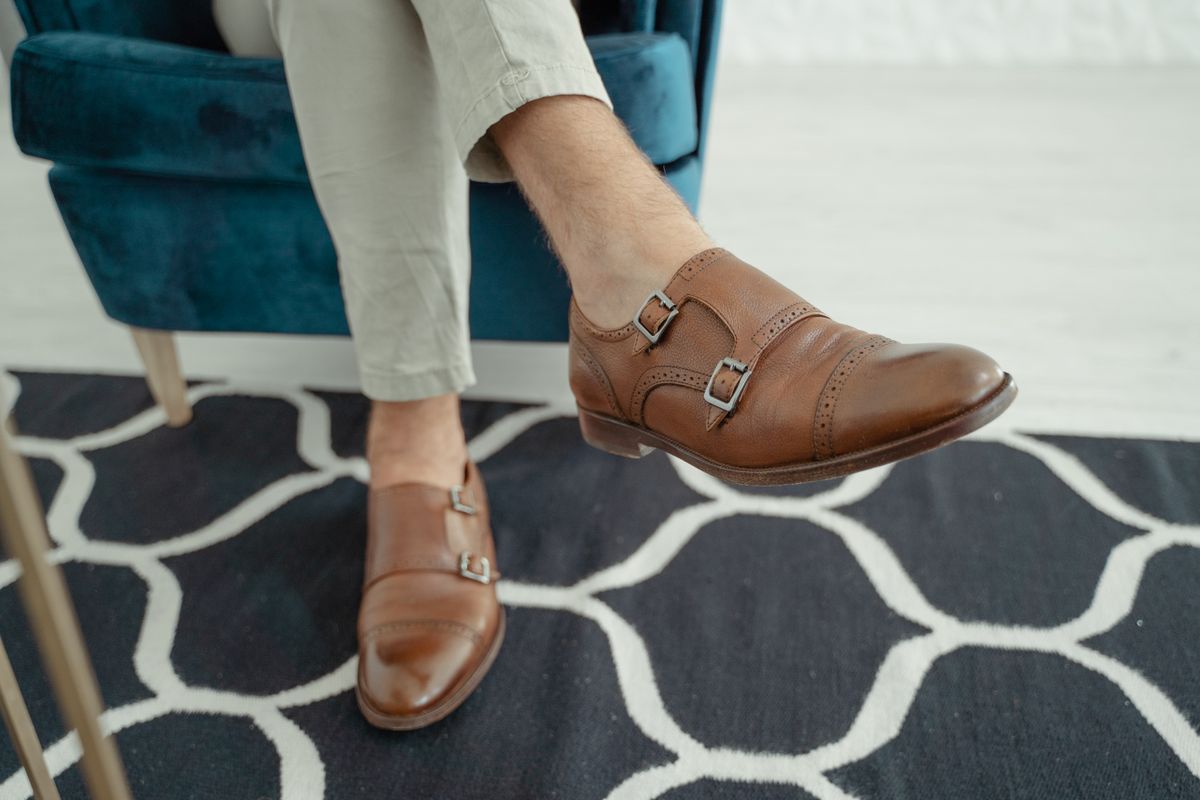
Monk strap shoes are laceless dress shoes that close with a leather strap and a metal buckle across the instep. A single monk has one strap. A double monk has two. In formality they sit below the Oxford and above the loafer, which means they work with a business suit, a blazer and chinos, or dark jeans, but not with a tuxedo.
The short version
- Definition: a strap and buckle replace the laces.
- Single monk: one buckle, plain and slightly dressier.
- Double monk: two buckles, more detail, more adjustable, more common.
- Formality: business and business casual. Not for black tie, and a risk in very conservative offices.
- Best first pair: a dark brown calfskin double monk with a cap toe.
- Trousers: hemmed with little or no break, so the buckles show.
What Are Monk Strap Shoes?
A monk strap is built like a lace-up without the laces. In place of eyelet facings, one side of the upper extends into a broad strap that crosses the instep and fastens to a buckle on the outer side of the shoe. Under the strap is a tongue, as on a lace-up. The rest of the shoe is ordinary dress shoe construction: a leather upper, a leather or rubber sole, and a low stacked heel.
The name comes from the buckled, closed-toe shoes associated with European monks, who are said to have worn them as a sturdier alternative to sandals. That origin story is traditional and not precisely documented. The modern double monk is widely credited to the London bootmaker John Lobb, whose William model dates to 1945.
Most monk straps have a small elastic insert behind the buckle. On those pairs you can set the buckle once and slip the shoe on with a shoehorn. On pairs without elastic, unbuckle the straps every time. Forcing your foot in stretches the strap and wears the buckle holes.
Single vs Double Monk Strap
| Single monk | Double monk | |
|---|---|---|
| Closure | One wide strap, one buckle | Two narrower straps, two buckles |
| Look | Clean and plain | Busier, more noticeable |
| Formality | Slightly higher | Slightly lower |
| Fit adjustment | One point, over the instep | Two points, so it holds the foot more like a lace-up |
| Usual toe | Plain toe | Cap toe |
| Best with | Suits, formal trousers | Suits, chinos, jeans |
| Pick it if | You want a quiet alternative to an Oxford | You want one pair that goes from suit to denim |
The formality gap between the two is small. Color, leather, and sole matter more. A black calfskin double monk on a leather sole is dressier than a tan suede single monk on rubber.
Triple monks and monk strap boots exist. Three straps is a fashion variation. A monk boot, with one or two buckles on an ankle-height shaft, is a good cold-weather option with flannel and tweed.
Are Monk Straps Formal?
Monk straps are dress shoes, but not the most formal ones. The metal buckle is decoration, and decoration lowers formality. Most menswear writers place them between Oxfords and loafers. Whether a monk strap ranks above or below a plain Derby is debated, and in practice the two are close.
| Dress code | Monk straps? | Notes |
|---|---|---|
| Black tie | No | Wear black patent or polished plain-toe Oxfords |
| Conservative business (law, finance, interviews) | Risky | A black cap-toe Oxford is the safe choice |
| Business | Yes | Black, dark brown, or oxblood calfskin |
| Business casual | Yes | The monk strap's best setting |
| Smart casual | Yes | Suede or lighter brown, with chinos or jeans |
| Weddings (guest) | Yes, unless black tie | Brown or oxblood for daytime, black for evening |
| Funerals | Acceptable in black | Plain black Oxfords are more traditional |
How to Wear Monk Straps
With a suit
| Suit | Monk strap color |
|---|---|
| Navy | Dark brown, oxblood, or black |
| Charcoal | Black or oxblood |
| Mid or light gray | Brown, oxblood, or black |
| Brown, olive, tan | Brown, darker than the suit |
| Black | Black only |
Trouser length matters more with monks than with any other dress shoe. A full break covers the buckles and bunches on the straps. Ask for a slight break or no break, with a hem opening narrow enough to sit cleanly on top of the shoe. For help choosing between the two main colors, see brown vs black dress shoes.
With chinos or wool trousers
Brown double monks with navy or gray trousers and a sport coat is the standard outfit. Suede monks in snuff or dark brown work with flannel, corduroy, and cotton chinos. A tie is optional.
With jeans
- Denim: dark indigo, slim or straight, with a clean hem or a single cuff that stops at the top of the shoe.
- Shoe: brown, tan, or suede double monks. A rubber sole fits the casual setting.
- Avoid: black high-shine monks, baggy or stacked denim, and distressed washes.
With shorts
It can be done with suede monks, tailored shorts, and no-show socks, but it is a strong look that many people dislike. A loafer is the easier choice with shorts.
Buckles and metal
Buckles come in silver-tone and brass or gold-tone finishes. Keep other visible metal in the same family: belt buckle, watch case, tie bar. An exact match is not needed. A brown shoe with a brass buckle and a belt with a brass buckle is enough. See how to match your belt to your shoes for leather color.
On double monks, some men leave the top strap unbuckled. It is a deliberate casual gesture, not a rule. Keep both fastened at work.
Socks
With tailoring, wear over-the-calf socks matched to the trousers. The short hem that shows off the buckles also shows your socks when you sit, so plain navy, charcoal, or a small pattern is safer than a loud one. In summer, no-show socks with cropped chinos work. See what socks to wear with dress shoes.
How Should Monk Strap Shoes Fit?
A strap adjusts less than laces. A lace-up closes along the whole instep through five or six pairs of eyelets. A monk closes at one or two points, with only a few buckle holes.
- Buckle position: the shoe should fit with the buckle on a middle hole. If you are on the last hole on day one, you have no room left as the leather stretches.
- Instep: the strap should lie flat with firm, even pressure. A strap that digs in means the instep is too low for your foot. A strap that floats means too much volume.
- Heel: firm hold with only slight lift. A single monk holds the heel less securely than a double, so check this first.
- Length: about a thumb's width, half an inch, in front of your longest toe.
- Width: the ball of the foot sits at the widest part of the shoe without pinching.
Men with high insteps often do better in double monks or Derbies than in single monks. Take the same size you wear in lace-up dress shoes, usually a half size below your sneaker size. The measuring steps are in how dress shoes should fit.
What to Look For When Buying
- Buckle placement: on a well-designed double monk the two straps are spaced apart and angled slightly, following the line of the foot. Straps that sit close together and parallel look cramped.
- Buckle quality: solid metal with a smooth roller or prong. Thin plated buckles chip and discolor.
- Elastic: a short elastic tab behind the buckle makes the shoe easier to put on and gives a little as you walk.
- Leather: full-grain calfskin for suits, suede for casual wear.
- Construction: a Goodyear-welted or Blake-stitched sole can be replaced, which is worth paying for in a shoe you plan to keep. The methods are compared in Goodyear welt vs Blake stitch.
- Brands: Beckett Simonon and Meermin for stitched construction at a moderate price, Carmina and Crockett & Jones higher up, and John Lobb's William as the reference double monk.
For specific models with construction, price tier, and drawbacks, see our picks for the best monk strap shoes for men.
Frequently Asked Questions
What are monk strap shoes?
Monk strap shoes are laceless dress shoes that close with a leather strap and a metal buckle across the instep. A single monk has one strap and buckle. A double monk has two.
Are monk straps formal?
They are moderately formal. A monk strap is less formal than an Oxford and more formal than a loafer. It works with business suits and business casual, but it is not correct for black tie or the most conservative dress codes.
What is the difference between single and double monk straps?
A single monk has one wide strap and one buckle, giving a plain, clean look that reads slightly dressier. A double monk has two narrower straps and two buckles. It is more eye-catching, more adjustable, and the more popular of the two.
Can you wear monk straps with a suit?
Yes. Dark brown, oxblood, or black monk straps in smooth calfskin work with navy, gray, and charcoal suits. Keep the trouser hem short enough, with little or no break, so the buckles are visible.
Can you wear monk straps with jeans?
Yes. Brown leather or suede double monks pair well with dark, slim or straight jeans hemmed or cuffed above the buckles. Black calfskin monks look too dressy with denim.
Should you leave the top buckle undone on double monks?
It is a styling choice, not a rule. Leaving the top strap unbuckled is a deliberate casual touch borrowed from Italian menswear. Buckle both straps at work and with a suit in any formal setting.
Can you wear monk straps to a wedding?
Yes, as a guest at most daytime, cocktail, and semi-formal weddings. For a black tie wedding, wear black patent or highly polished plain-toe Oxfords instead.
What socks do you wear with monk strap shoes?
Wear over-the-calf or mid-calf dress socks matched to your trousers with a suit. With chinos or cropped trousers in warm weather, no-show socks work, since the strap holds the shoe securely.